





AI Agents Take the Search for Alien Life to a Whole New Level
 Story by:
Incredible News
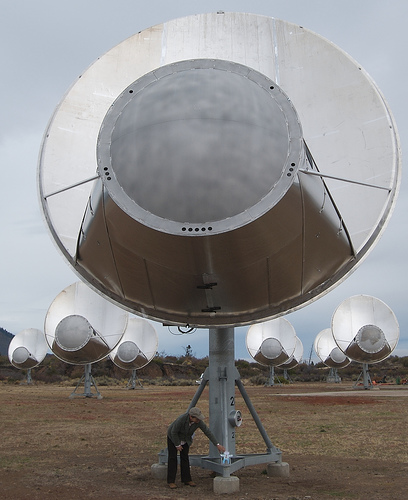
AI is giving scientists new ways to search for signs of life beyond Earth. At the Allen Telescope Array in California, AI agents can now control telescopes, process huge amounts of data and look for possible signals from distant civilizations. The technology has already helped detect a pulsar in real time, marking a new step in the search for extraterrestrial intelligence.
Scientists at the Allen Telescope Array have integrated the NVIDIA Holoscan platform to search for signals that may come from aliens — or the AI they built, according to NVIDIA news.
The new system brings together several technologies to make the search for extraterrestrial intelligence faster and easier. At the Allen Telescope Array, AI agents can respond to simple language instructions to control the telescope and improve incoming data and search for possible signals. This allows scientists to manage several tasks through one system instead of handling each step separately.
One of the main challenges in radio astronomy is the enormous amount of data collected by telescopes. The Allen Telescope Array can produce terabits of data every second – making it difficult to process and study everything in real time. To address this, the team uses NVIDIA Holoscan, which allows large amounts of sensor data to be processed directly by GPUs without first storing everything on hard drives.
Another important part of the system is CyberEther, a signal-processing framework developed by the SETI Institute. It uses NVIDIA CUDA-X tools, including cuFFT and cuBLAS, to process the incoming signals. This helps scientists examine telescope data more efficiently and identify information that may be worth investigating.
The system also uses Nexus a web-based platform that connects AI agents with the telescope and its computing resources. Through simple natural language instructions, researchers can monitor data, view live spectrograms and make changes to signal-processing tasks. Running on NVIDIA RTX PRO 6000 Blackwell GPUs, the system can handle up to 2.4 terabits of data per second, with AI processing taking place at the observatory.
By bringing these technologies together, AI agents can perform tasks that would otherwise take scientists weeks or even years. They can help point the telescope, adjust its settings, correct data errors and display results for further study. This gives researchers more time to examine interesting findings and explore possible signs of extraterrestrial technology.
The system has already recorded an important scientific achievement – the first real-time AI detection of a pulsar in the Crab Nebula. A pulsar is the remains of a star that spins rapidly and sends out regular pulses of radiation. Looking ahead, the team is testing open AI models including NVIDIA Nemotron which could be useful for observatories that need to process data locally or operate without an internet connection. This could eventually support future observatories located in remote places – including the far side of the moon.



Comments 0
No Readers' Pick yet.