








Biggest Pools in the World: Sizes, Locations, and Record-Holders
 Story by:
Incredible Discoveries
Story by:
Incredible Discoveries
The question of the biggest pool in the world is a topic that sounds like it should have a crystal-clear answer. After all, biggest means biggest. Find the measurement, crown the winner, move on.
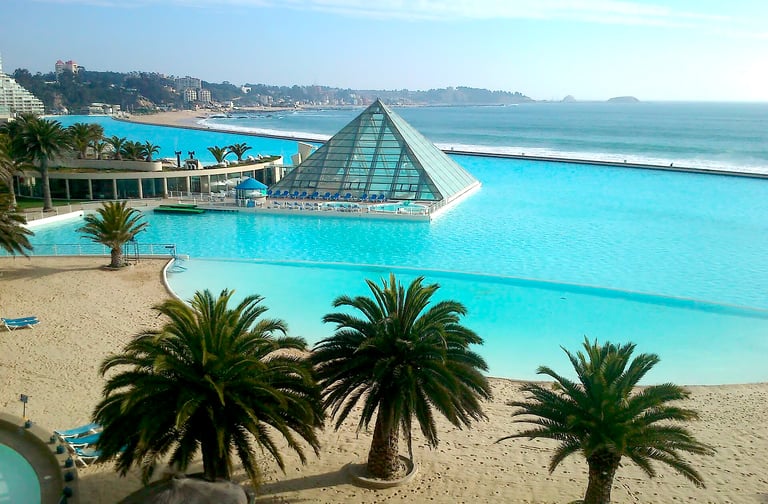
Today, Citystars Crystal Lagoon in Egypt is the clear winner, while the pool at San Alfonso del Mar in Chile is widely considered the most iconic mega-pool in the world. Opened in 2006, San Alfonso del Mar held the record until it was surpassed by the Citystars Crystal Lagoon in 2015. The San Alfonso del Mar pool is the giant blue expanse people see online and immediately assume must have been Photoshopped. Even today, when you search for the world’s largest pool, many results incorrectly identify it as being the biggest.
Maybe it gets mistaken for being the record-holder because it held the record for almost a decade, or maybe it’s because the visually stunning vista gets more attention on social media. Either way, both are true mega-pools. People swim in them, sure. But at this scale, swimming is just the starting point. Guests also kayak, paddleboard, sail in designated areas, or simply lounge beside a body of water so large that it feels less like a pool and more like a private inland sea.
Video: Aerial View of San Alfonso del Mar
What is the Biggest Pool in the World?
The biggest pool in the world by surface area is Citystars Crystal Lagoon at Citystars Sharm El Sheikh in Egypt. The man-made crystalline lagoon covers about 28.8 acres, surpassing San Alfonso del Mar in Chile, the previous record holder.
How the World’s Biggest Pools Compare by Features
|
Pool or Lagoon |
Location |
Why the Pool Stands Out |
|---|---|---|
|
Citystars Crystal Lagoon |
Sharm El Sheikh, Egypt |
Currently the biggest pool in the world by surface area, covering about 28.8 acres in the middle of the desert. |
|
San Alfonso del Mar |
Algarrobo, Chile |
The most famous mega-pool in the world, known for its long, bright-blue lagoon beside the Pacific Ocean. |
|
Surf Abu Dhabi |
Abu Dhabi, United Arab Emirates |
Recognized as the world’s largest wave pool, built to generate artificial waves instead of still resort water. |
|
Seagaia Ocean Dome |
Miyazaki, Japan |
A once-famous indoor beach-style pool with artificial waves and controlled weather, though it closed in 2007. |
|
Deep Dive Dubai |
Dubai, United Arab Emirates |
The world’s deepest swimming pool, reaching 60.02 meters and built for diving rather than casual swimming. |
|
Laguna Bahía |
Algarrobo, Chile |
Another Chilean artificial lagoon that shows how San Alfonso del Mar helped inspire similar resort-style lagoon developments. |
Where is the Biggest Pool in the World?
The Citystars Crystal Lagoon is located in Egypt’s Sinai Peninsula, near the Red Sea resort city of Sharm El Sheikh. That setting is part of what makes the lagoon feel so strange. Instead of spanning along the ocean and being sandwiched by forests like San Alfonso del Mar, it sits in the desert, where a massive blue artificial lagoon looks like an oasis dropped into the sand. The contrast is the point: dry desert landscape on one side, bright resort water on the other.
As for the pool at the San Alfonso del Mar resort, it’s in Algarrobo, Chile, a coastal town west of Santiago. It sits right along the Pacific coast, quite the contrast from its counterpart in the Sainai desert. A pool of this size right next to the ocean is similarly intriguing.
You already have the ocean right there. A real ocean. Then, beside it, someone built a calmer, clearer, more approachable copy of it.
That contrast is the hook.
The Pacific is rougher, colder, darker, and rather unforgiving for casual swimmers. There are strong currents, seaweed, and the unnerving thought of whatever creatures you might be sharing the water with. The lagoon at San Alfonso del Mar, on the other hand, is bright, filtered, still, and built for people. It gives you the look of ocean water without fear of choppy waves or huge swells.
That may sound excessive, and, admittedly, it is. But it gets people talking.
How Big Is Citystars Crystal Lagoon?
When it comes to the actual biggest pool in the world, the record is pretty mind-boggling. Citystars Crystal Lagoon is 28.8 acres, according to its website. That’s almost a third larger than San Alfonso del Mar.
Given its desert setting, you might wonder, “How could anyone possibly fill a pool that large?” One might assume it would risk being a waste of water; however, it is actually filled using subterranean saltwater that can’t be used for drinking or watering crops. A truly resourceful feat of innovation.
To put its size into perspective, it would take over 90 Olympic swimming pools to match its size.
Part of the confusion comes from the word “pool.” At a certain size, are we still talking about a swimming pool? Or are we talking about an artificial lagoon, a resort lake, or a planned water feature that people happen to swim in?
The answer depends on who is ranking it. Convenient, right?
Incredible Facts About Citystars Crystal Lagoon
How Big Is the San Alfonso del Mar Pool?
The numbers are the reason San Alfonso del Mar pool became famous in the first place.
It is about 1,013 meters long, which is over a kilometer. It covers around 20 acres. It holds about 66 million gallons of seawater.
Those are big numbers, but they are also a little hard to feel. Most of us do not walk around with a working mental image of 20 acres of pool water. That’s double the size of a large golf hole.
So think of it this way: a normal resort pool is something you swim across. San Alfonso del Mar is something you’d cross in a kayak.
It is not just a chlorinated rectangle. It is a long, engineered lagoon that changes the entire shape and feel of the resort. From certain angles, it stops reading as an amenity and starts looking like a small inland sea that got very good branding.
Incredible Facts About San Alfonso del Mar
Why Did San Alfonso del Mar Get So Famous?
Photos helped. A lot.
San Alfonso del Mar is one of those spectacles that makes immediate sense in an image. Long blue lagoon. Resort buildings. Pacific Ocean in the background. Tiny-looking people and boats. You don’t need much context to understand that it is unusual.
It also has that classic internet quality of looking fake even when it isn’t. The water is too blue. The shape is too long. The ocean is too conveniently placed right beside it. Everything about it feels like a travel-photo exaggeration.
But the basic thing is real. It is just a very large, very managed lagoon sitting next to the actual coast.
In person, the scale is probably the bigger deal. Photos show the color and shape, but they do not fully explain the length. It keeps going. That is what turns it from a pool into a place people talk about later.
A normal pool is often just a pleasant backdrop for a photo. This one actually becomes the subject.
Records Worth Debating
Record confusion is not unique to pools. The same thing happens with the biggest diamond in the world, where the answer depends on whether you mean rough size, cut size, gem quality, or historical importance. “Biggest” sounds simple until someone asks, “In what sense?”
Biggest Indoor Pool in the World
Indoor pools are another category, as you can only fit so much under one roof. The atmosphere also changes quite a bit when you take away the bright sun and palm trees.
The Seagaia Ocean Dome in Japan is one of the more famous examples people bring up. It was basically an indoor beach, with artificial waves and controlled weather. Unfortunately, it closed in 2007, and no other pool has come close to being larger.
Tropical Islands Resort in Krausnick, Germany, is often mentioned in this category because Guinness recognizes it as the largest indoor water-based theme park. That is slightly different from saying it has the single largest indoor swimming pool, but it still belongs in the conversation about extreme indoor water attractions.
Even with that distinction, Tropical Islands is still absurdly impressive. The resort sits inside a former airship hangar, which helps explain why the space feels less like a normal indoor pool and more like a manufactured tropical world, complete with warm air, beaches, plants, water attractions, and enough room to make the “indoor” part feel almost impossible.
An indoor pool can be impressive, but it is playing a different game from an outdoor lagoon that spans over a kilometer.
Deepest Swimming Pool in the World
The biggest pool in the world is impressive because of its sheer size. The deepest swimming pool in the world is impressive for the exact opposite reason.
That title belongs to Deep Dive Dubai in the United Arab Emirates. Opened in 2021, the pool reaches an astonishing 60.02 meters (196 feet, 10 inches) deep, earning the Guinness World Record for the world’s deepest swimming pool.
Rather than being built for lounging, Deep Dive Dubai was designed for scuba diving, freediving, and underwater exploration. The pool holds roughly 14 million liters (3.7 million gallons) of freshwater and features an elaborate underwater environment complete with a submerged “abandoned city” that divers can explore. There are streets, apartments, arcade games, and even a library, all sitting far below the surface.
Of course, this isn’t a place where most visitors jump in for a casual swim. Divers descend through carefully controlled conditions with professional supervision, while large observation windows allow spectators to watch the action from above.
Like San Alfonso del Mar, Deep Dive Dubai pushes the definition of what a swimming pool can be. One stretches the concept horizontally across more than a kilometer. The other takes it straight down nearly 200 feet. Both are engineering marvels, but they showcase completely different kinds of extremes.
Biggest Wave Pool in the World
Wave pools are a different category, and they probably should not be lumped in too quickly with mega-pools like the Citystars Crystal Lagoon.
A giant lagoon like this is all about scale and calm water. Wave pools are about movement and excitement. Their whole purpose is to generate artificial waves for surfing, training, or entertainment.
That makes the engineering goal different. Citystars Crystal Lagoon is trying to keep a huge amount of water clean, clear, and usable. A wave pool is trying to create consistent motion. Those are not the same problem.
Unlike the biggest pool, the biggest wave pool in the world is less of a sought-after title, so searches will yield different results. However, after sorting through results, the current record holder is Surf Abu Dhabi, according to Guinness World Records.
Completed in 2024, it covers an astounding 18 acres. While it may be two acres smaller than San Alfonso del Mar, it’s impressive to think that the entire surface is in a constant state of motion.
So yes, both are artificial water attractions. But comparing them too directly is a little like comparing a lake to a treadmill because both can make you tired.
Other “Biggest Pool” Titles Around the World
While some records are hotly contested and sought after, others are just living in their own world. Still, it’s fun to learn about them and what makes them unique.
Other Huge Pools and Artificial Lagoons
While they may not be the biggest, there are other pools worth writing home about.
Laguna Bahía is another Chilean example that shows how much this category has expanded beyond ordinary swimming pools. Located in Algarrobo, the same coastal area as San Alfonso del Mar, it uses the same basic idea of turning a resort-style development around a large artificial lagoon. It is not the record-holder, but it helps explain why Chile became so closely associated with giant crystalline lagoons in the first place. Once San Alfonso del Mar proved that a pool could function more like a private beach or calm inland bay, other developments followed the same blueprint on a smaller scale.
That is where the category gets messy. A backyard pool and a 20-acre artificial lagoon are technically connected by the same word, but come on. They are not really the same thing.
Still, “biggest pool in the world” is what people search. So that is the phrase everyone uses, even when the better word might be lagoon.
Who Builds the Biggest Pools in the World?
You’d think that there are many pool construction companies out there that are all vying for the title of world’s largest pool. While that may be the case for the venues where the biggest swimming pools are held, the builders behind it are a different story.
This is because most of the largest pools in the world are all built by the same company, including the pools at Citystars Sharm El Sheikh and San Alfonso del Mar. That company is Crystal Lagoons. Currently based out of Miami, they build swimming-friendly artificial lagoons all over the world.
The company was actually founded by Fernando Fischmann, a Chilean businessman, and the original developer of San Alfonso del Mar. He wanted a massive pool complex on the property, but there was no existing filtration technology that could maintain a pool of the scope and size he imagined.
Instead of scaling back the pool, he funded the development of a new filtration technology that uses hundreds of sensors to strategically target areas in the pool where algae or bacteria build up.
Once patented, he figured, why stop at just San Alfonso del Mar? The technology was patented and Crystal Lagoons was then founded to construct mega-pools all over the world. Currently they have over 1,000 projects at various stages of developmentdevelopment worldwide in over 60 countries.
Crystal Lagoons’ Biggest Pool Projects
Of the ten biggest pools in the world, five of them are built by Crystal Lagoons:
How Are the Biggest Pools in the World Maintained?
The crystal blue water is a major part of the appeal for any mega-pool. However, both Citystars Crystal Lagoon and San Alfonso del Mar are far too large for any conventional pool filtration technology to keep up with. As a result, both use a patented filtration system which is an accomplishment of its own.
These pools use an ultra-sonic filtration technique, where soundwaves are used to corral any growing algae or bacteria towards designated areas in the pool. From there, sensors detect where they’re concentrated and strategically deploy chlorine to eliminate impurities.
By strategically employing when and where filtration occurs, these pools actually only use only a fraction of the chemicals compared to a standard pool, and far less energy as well. Both pools also tap into readily available salt water to fill and maintain the pools, so local sources of fresh water aren’t being depleted.
That is the part people tend to miss. The size gets all the attention, but the control is what makes it work. Lots of places have water. This is water that has been shaped, managed, and kept usable across a ridiculous amount of space, and innovation keeps it economically viable.
Are Mega Pools Just for Swimming?
You can swim in San Alfonso del Mar, but swimming is only part of the appeal.
Because the lagoon is so large, guests can also kayak, paddleboard, and even sail in certain areas. That sounds odd if you are thinking of a hotel pool with a deep end and a rope line. It makes more sense when you see the size of the place.
Some people use it like a pool. Some use it like a calm little bay. Some barely use it at all and just sit nearby, which is probably the most honest vacation activity ever invented.
A mega-pool of this size also changes the way the resort feels. Usually, if a property is next to the ocean, the ocean gets top billing. Here, the man-made water feature competes with it. It’s a weird concept, but it’s true.
The Enduring Appeal of the World’s Biggest Pools
Nobody needs a pool this large. That is probably worth saying out loud.
You do not need 66 million gallons of water to swim. You do not need a kilometer-long lagoon to relax. You definitely do not need a pool so large that kayaking becomes a reasonable way to get across it.
But that is why San Alfonso del Mar is interesting. It is not practical in the ordinary sense. It is not just a place to cool off. It is a resort feature that became famous because it pushed the idea of a swimming pool past its normal limits.
That kind of excess can be ridiculous, but it can also be memorable. In this case, it is both.
San Alfonso del Mar may not be the current technical winner in every version of the biggest pool ranking. Citystars Crystal Lagoon has a strong claim by area. But San Alfonso del Mar remains the one people remember, and in a topic built partly on spectacle, that counts for a lot.
It is a giant pool, a man-made lagoon, a travel oddity, and a slightly absurd piece of resort engineering all at once.
Not a bad legacy for something people technically use to float around.
Feature Photo Credit: Wikimedia Commons/Ro027


Comments 0
No Readers' Pick yet.