








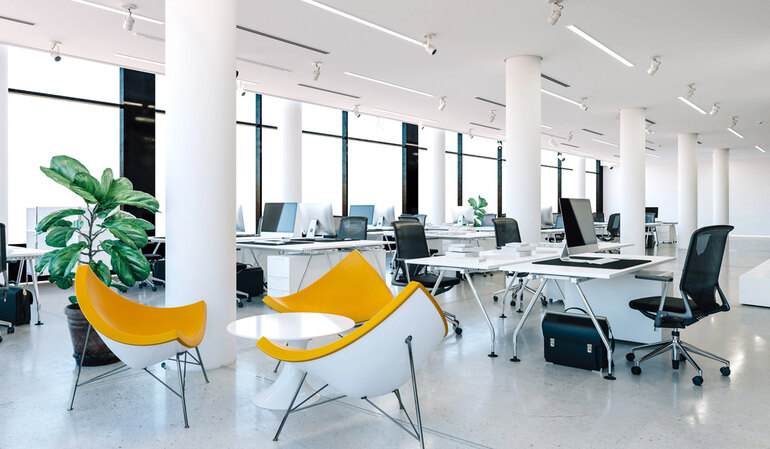
How Modern Workplaces Are Using Design to Reduce Noise
 Story by:
Marc Ikbal
Story by:
Marc Ikbal
Earlier, it was all about desks in the workplace; now, workplace design is all about how we think, feel and work together. One of the greatest unrecognised and next-gen threats to evolution is noise. Studies in the field of cognitive Psychology and neuroscience have found that low-level background sounds are able to have an impact on concentration and cause lip services to be given to a task by constantly distracting the brain and thereby presenting a challenge to concentration, mental fatigue and overall productivity.
However, silence is not the answer as per the Goldilocks concept: the sound level is more optimal. While open-plan offices make working with a team more collaborative, they can also be a distraction. There are many ways to keep concentration from dropping; somebody calling someone, video meeting, short conversation, and walking around the office. Today, many businesses are utilising design as a viable approach to quieten noise and make the workplace more pleasant.
Why Noise Control Matters in Modern Offices
Noise is a problem in the workplace, and it is not something to take lightly. It may impact labour productivity, privacy, and the health of employees. Many workplaces have employees who are required to perform varying tasks during the day. They can go on a video call, concentrate on specific work activities, be involved in team discussions or receive a private phone call. All of these activities can create distractions when they are happening within the same open space, making it difficult to focus and thereby limiting what can be achieved to enhance performance. This is one of the reasons why, in recent times, acoustic planning has come into the picture. Companies aren’t just taking design into account when it comes to designing an office, but they are also thinking about how it sounds and how it works.
Creating Different Zones for Different Work Styles
This has been one of the most popular works out there to create various work zones inside the office. Open collaboration spaces, quiet work zones, meeting rooms, phone booths and informal lounges are all features of a workplace that are not seen as outdated and irrelevant. This enables workspace selection based on what employees are working on.
For instance, tasks might be undertaken in a collaborative zone with a team dialogue in a quieter zone. Other brands, like Steelcase, Herman Miller and Haworth, are more emphatic about the subject of flexible workspace planning, demonstrating how the furniture, layout and zoning can accommodate various work styles. With this broader movement in the industry, acoustic comfort is no longer to be seen as just a feature placed after design, but an integral design consideration.
Using Partitions to Improve Privacy and Sound Control
Well-designed partitions are one of the best solutions for managing sound in an open office. One way for companies to do this is to create temporary walls with movable options that can divide up rooms while maintaining a seamless open office space. It’s an area in which JEB Group has thrived, particularly with acoustic partition designs for contemporary workplaces. Its office partitions are built to allow businesses to make more private, comfortable and acoustically pleasing environments without sacrificing the benefits of an open plan environment. Partitions are particularly helpful to companies that wish to develop using a contemporary and clean office design and experience a lot of connected workspaces and meeting rooms.
Combining Function with Aesthetic Design
Workplace noise reduction does not have to look technical or unattractive. A wealth of acoustic products is now available that fit into the office space interior. Acoustic panels are useful in reflecting and absorbing sound but can also bring a visual warmth to a space, as can fabric finishes, ceiling treatment, carpeting and upholstered furniture.
Other brands like BuzziSpace and Framery have also demonstrated that products can be both sound-absorbent and design-forward, ranging from furniture designed with sound-absorbing properties to call and meeting areas designed with pods. This is essential as modern offices are expected to be welcoming, warm, and professional. Well-designed acoustics should enhance well-being throughout the workplace and also promote productivity.
Supporting Hybrid Work and Video Meetings
The concept of ‘hybrid’ has also posed new challenges to the use of the offices. Formerly, when an employee was at the office, she spent endless time on video calls; now she is spending more. Unless properly designed, these calls can lead to noise pollution and decrease privacy for the caller. To overcome this, there are many offices that are introducing phone booths, small meeting rooms, acoustic pods, or even separating meeting areas. These rooms can be used to make calls and set up small discussions without disturbing the rest of the office. This is where flexible acoustic solutions are of value. They enable enterprises to utilise their workspaces in innovative ways, regardless of the fact that the interior needs no renovation.
Balancing Collaboration and Focus
It is not a good thing when there are no voices at all for a successful workplace. Teamwork, dialogue, and work dynamics are all essential aspects of the office. The aim is to manage sound in a manner which enables effective collaboration and focus. This can be achieved through effective acoustic design, to position areas of collaboration with high levels of noise away from areas of calm or quiet, to apply partitions to prevent noise from travelling to the wrong place, and to install sound absorption materials in areas where sound is likely to happen.
Carefully designed, an employee can easily access any area of the office the relevant to the work in progress, enabling the room to function either as an environment for brainstorming or an environment for concentrated work. Today, many workplace brands are concerned with finding the balance between openness and solitude, which is an open space conducive to connection and a space conducive to productivity.
Why Acoustic Design Is Becoming a Workplace Priority
Comfort and function are more important than appearance as companies are more and more rethinking how they’re going to use the office. Workspaces are supposed to foster optimal work performance and not to overwhelm the employee’s focus. This evolution can be attributed to a number of brands which are making various efforts towards it, such as JEB Group’s office furniture, Steelcase’s Living Room Office, Herman Miller’s furniture, Framery’s office spaces and BuzziSpace’s living spaces. Some are on partitions and space design, and others are on furniture, pods or sound-absorbing products. They combine to indicate a greater shift towards smarter and more humanised design in the workplace.
Designing for Better Work
The first step to reducing workplace noise is no longer asking employees to be quiet. It’s more than just designing an office for people to work in, but also how they work. Acoustic partition, flexible zoning, acoustically absorbable material and improved meeting spaces can transform modern work spaces into more productive, comfortable and enjoyable workplaces. The increased hybrid working models and employee concerns have opened the door to increasing evidence that acoustic design is now a great science-based tool to engineer human performance, and as workplaces continue to change, it is poised for continued growth and development into the future, while also raising important considerations around the legality of workplace environments.
Neuro- and environmental-science findings reveal that more than comfort is involved in creating a good sound environment; it has a direct link to focus, creativity and collaboration within that environment. Just like engineers maximise the functions of extreme structures and innovators explore the technological limits, modern offices are being designed at a sensory level, with even imperceptible elements such as sounds creating sensory barriers to or facilities for human potential.





Comments 0
No Readers' Pick yet.