


COFE+ Robot Beats Award-Winning Human Barista in Five-Drink Coffee Showdown
 Story by:
Incredible News
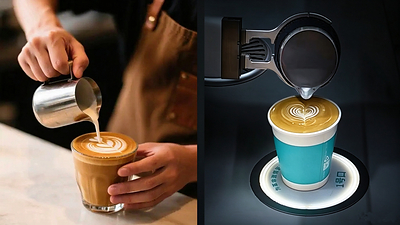
A robot barista has beaten an award-winning human coffee maker in a five-drink speed challenge, according to results released by its developer. At the 7th LD International Coffee Masters Competition in Yiwu, China, on November 14, 2026, the seventh-generation COFE+ system finished every tested beverage faster than its human competitor.
The contest, held during the 2026 China Yiwu Imported Commodities Fair, also compared the weight consistency of five lattes prepared by each side. COFE+ produced a much tighter range of weights, although the supplied results do not establish which drinks tasted better.
Five Drinks, Five Faster Finishes
The organizers measured the full serving process, starting when an order was placed and ending when the finished drink reached the judges. That included cup collection and handover, not just brewing.
COFE+ averaged 49.4 seconds per drink, compared with 57.2 seconds for the human barista. Its biggest advantage came in the swan-design latte-art challenge, where it finished 18 seconds sooner.
| Beverage | COFE+ | Human |
| Espresso | 30 s | 32 s |
| Cappuccino | 36 s | 40 s |
| Classic latte | 43 s | 48 s |
| Swan-design latte art | 70 s | 88 s |
| Audrey Hepburn portrait latte (3D foam printing) | 68 s | 78 s |
More Consistent Latte Weights
Each competitor also made five lattes that were weighed on site. COFE+’s cups weighed 232.5, 232.2, 233.3, 234.7 and 230.0 grams, averaging 232.54 grams. The human barista’s cups weighed 233.7, 232.1, 230.2, 246.2 and 225.9 grams, averaging 233.62 grams.
The robot’s sample standard deviation was 1.72 grams, compared with 7.61 grams for the human barista—about 4.43 times as much variation. That suggests more repeatable portioning in this small test, but weight alone is not a measure of flavor or overall coffee quality.
What Makes the COFE+ Robot Work?
Developed by Shanghai Hi-Dolphin Robot Technology, COFE+ combines a six-axis robotic arm with grinding, extraction, milk steaming and automated beverage assembly. The company says the seventh-generation kiosk can produce more than 300 drinks across eight categories and print images or text onto foam.
Its compact café unit occupies approximately 2.35 square meters and is designed for use in locations such as airports, hospitals, universities and shopping centers. The company also promotes remote monitoring of inventory, sales and equipment status.
The demonstration is part of a wider push to bring robots into everyday services. Other companies are pursuing similar real-world automation, from Flourish’s household chore robot to KRAFTON’s research into robots that understand human instructions.
What the Competition Does—and Does Not—Prove
The Yiwu results show that COFE+ was faster in the five reported tasks and more consistent in measured latte weights. They do not, on their own, demonstrate superiority in taste, hospitality, creativity or performance across different cafés and service conditions.
Shanghai Hi-Dolphin describes the result as a world-first achievement and says its robotic café model can lower operating costs by up to 90% and electricity use by up to 80%. Those are company claims; the supplied material does not include independent verification or the assumptions needed to assess those savings. Still, the head-to-head comparison offers a striking glimpse of how automated coffee service is evolving: a robot can now compete on not only speed but also intricate presentation, including latte art and foam printing.


Comments 0
No Readers' Pick yet.