


Voyager 1 Is Now a Full Light-Day From Earth
 Story by:
Incredible News
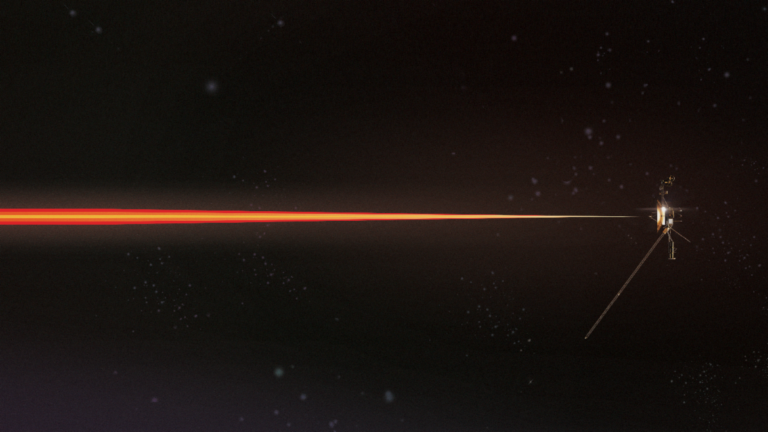
A signal from Voyager 1 now needs a full day to reach Earth. After more than 49 years of travel, the spacecraft reached one light-day from home on November 18, 2026, putting it roughly 16.1 billion miles (25.9 billion kilometers) away.
NASA announced the milestone the following day. The probe crossed the threshold at 5:16 a.m. EST on November 18, but its signal needed another 24 hours to reach the team on Earth.
The celebration comes with a complication: as of NASA’s November 19 update, the team had not received science and engineering data from Voyager 1 since November 14. A carrier signal was still arriving. Engineers used that signal and trajectory calculations to confirm the distance while investigating the missing data.
What one light-day actually means
A light-day measures distance, not the time a spacecraft takes to travel it. Voyager 1 did not make the journey in 24 hours; its radio signals travel at the speed of light, while the probe took nearly half a century to get this far.
For mission controllers, that means roughly 48 hours of signal-travel time for a command to go out and a reply to come back, before allowing for any processing or troubleshooting. That delay makes even a single exchange a multiday undertaking.
“It just takes a little longer to communicate than it used to,” said Suzanne Dodd, Voyager project manager at NASA’s Jet Propulsion Laboratory.
Beyond the Sun’s protective bubble
Launched in 1977, Voyager 1 and its twin, Voyager 2, explored Jupiter and Saturn. Voyager 2 continued on to Uranus and Neptune, while Voyager 1 headed toward its next frontier.
In 2012, Voyager 1 became the first spacecraft to enter interstellar space after crossing the boundary of the heliosphere, the bubble of particles and magnetic fields created by the Sun. Voyager 2 crossed in 2018. This week’s milestone marks distance from Earth, not a new entry into interstellar space.
Keeping a 1977 spacecraft running
Each Voyager loses about 4 watts of power annually as its nuclear power source ages. This year, engineers switched off three devices on Voyager 1 and used three lower-power alternatives to stretch the output of its generator, which converts heat from decaying plutonium into electricity.
NASA expects its latest energy-saving work to provide enough power for both probes’ current science instruments to operate through at least their 50th launch anniversaries in 2027. That is a power forecast, not a guarantee of uninterrupted data: Voyager 1’s current transmission problem remains under investigation in the agency’s November 19 update.
Both spacecraft also carry a Golden Record, a gold-plated copper disc containing sounds and images from Earth. It is a message for any advanced civilization that might someday encounter them, traveling far beyond the world that sent it.



Comments 0
No Readers' Pick yet.