





Notre Dame University Engineers Develop a 30-Foot Search and Rescue Vine Robot
 Story by:
Incredible News
Story by:
Incredible News
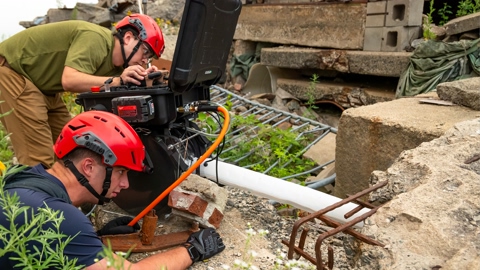
The University of Notre Dame is developing a flexible robot designed to help search-and-rescue teams find people trapped in collapsed buildings. The inflatable “vine robot” can move through tight spaces while using a camera and acoustic sensors to help responders search safely. Tested with first responders, the technology could make it easier to assess dangerous areas before rescue crews enter.
A press release from The University of Notre Dame explained that the soft robot can twist around obstacles and extend up to 30 feet into narrow void spaces while carrying a camera at its tip.
Acoustic sensors distributed along its body could also help map a route through the debris, giving search and rescue teams the information they need to locate survivors and plan how to reach them.
It is worth appreciating that when a building collapses, first responders face a high-stakes challenge: Find people trapped beneath concrete and debris without putting rescue crews at greater risk.
Across the country, urban search and rescue teams are called on to respond when disasters leave people trapped in collapsed structures. The Federal Emergency Management Agency (FEMA) has 28 urban search and rescue task forces nationwide, responding to emergencies ranging from hurricanes and tornadoes to structural collapses and other disasters.
Current tools are useful but have limitations. Specially trained dogs can detect human presence beneath rubble, and acoustic devices can help determine depth. Search cameras can provide a view inside, but because they are typically mounted on telescoping poles, they are limited by the narrow, twisting voids common in collapsed structures.
Extending the reach of search and rescue teams
It is against this background that Margaret McGuinness, assistant professor of aerospace and mechanical engineering at the University of Notre Dame, and her team have developed the flexible, inflatable “vine robot” that offers another approach.
“Every second counts when you’re trying to rescue someone who might be trapped after a building collapses,” McGuinness said.
Developed in collaboration with researchers at MIT Lincoln Laboratory, the technology is designed to improve situational awareness—not replace the people doing the rescuing.
Built with first responders, not just for them
First responders are playing an active role in shaping how the technology is tested and refined.
McGuinness and her team are developing the technology in close partnership with search and rescue professionals who understand firsthand how it would need to perform in the field.
McGuinness and her team have tested the Soft Pathfinding Robotic Observation Unit, or SPROUT, with urban search and rescue professionals at a mock collapsed building in Massachusetts and are now working closely with Clay Fire’s regional search and rescue team in South Bend, Indiana.
Their feedback is helping researchers adapt the robot to the complex conditions that responders encounter in the field, helping teams narrow their search and better understand an unstable environment before entering it.
That capability could eventually have applications beyond disaster response. Similar technology could support national security and humanitarian response efforts by helping assess damaged structures in conflict zones or other high-risk environments before sending personnel inside.
About the University of Notre Dame
The University of Notre Dame is a leading Catholic research university and a member of the Association of American Universities (AAU), a consortium of the nation’s leading public and private research universities. The only explicitly religious institution in the AAU, Notre Dame advances research and scholarship in service to humanity, pursuing discoveries that address complex challenges, improve lives and contribute to the common good.


Comments 0
No Readers' Pick yet.